Resources for Navigating Breast Cancer Care During the COVID-19 Pandemic
The COVID-19 pandemic has impacted everyone across the globe. Confusion, fear, and safety protocols continue to make navigating breast cancer screenings and treatment more difficult than ever. Although data and recommendations are constantly evolving, we present some helpful information below to address the most common questions we see relating to breast cancer care during the pandemic.
Breast Cancer Screening
Leading health organizations and medical professionals agree it is safe to resume breast cancer screening. The importance of resuming annual screenings and/or diagnostic imaging tests cannot be understated. With safety protocols in place at every medical facility, patients can more confidently go to these appointments as long as they adhere to the recommended guidelines, such as wearing a face mask/covering and physical distancing as much as possible.
Treatment Options
Many patients today are reporting delays in their breast cancer surgery due to the limitations in place within hospital systems. These limitations help ease the burden on the healthcare system created by COVID-19. The impact of these delays has raised obvious concerns from patients and medical professionals alike.
Luckily, more hospitals and surgical centers are opening up and breast cancer surgery delays are becoming less frequent. Currently, treatment options like chemotherapy and radiation are continuing as normal and patients should follow their healthcare team’s recommendations.
As a helpful resource, the American Society of Breast Surgeons has published recommendations to help guide physicians and their patients through the common scenarios related to breast cancer treatment during the COVID-19 pandemic.
COVID-19 Vaccines
Vaccine distribution regulations vary by state, but in many areas breast cancer patients are eligible to receive the vaccine now. Before receiving the COVID-19 vaccine, patients should consult with their medical team.
There’s a lot of confusion among breast cancer patients as to whether the vaccine is a good idea or a bad idea for somebody undergoing treatment. Reports of lymph node swelling after a vaccine that mimicks breast cancer spread (metastasis) has obviously caused a lot of concern. However, this should not be mistaken for disease progression. It is also very understandable for some of you to feel uncomfortable receiving a vaccine that is so new and has been developed so quickly. However, please know that new vaccines cannot be released for public use without the appropriate safety protocols being followed.
Breast Reconstruction Timing
For many, breast reconstruction has had to be rescheduled or postponed due to their local hospital infection rates and bed capacities. This can be extremely frustrating to say the least. However, please know that delayed reconstruction is still possible any time after a mastectomy (or lumpectomy).
For current scheduling availability and recommendations in your area, please keep in close touch with your plastic surgery team.
Related content:
Coronavirus: What Breast Cancer Patients Need To Know
The Impact of COVID-19 on Breast Cancer Treatment
Breast Advocate Founder Answers Your COVID-19 Breast Cancer and Breast Reconstruction Questions
Rescheduling Elective Breast Surgery After COVID-19
COVID-19 Patient Outcomes After Breast Cancer Treatment
Breast Cancer Vaccine set for Clinical Trials
The new year is kicking off with hopeful news about a breast cancer vaccine. The US Food and Drug Administration (FDA) approved a new vaccine for triple-negative breast cancer to enter clinical trials. Invented and developed by Cleveland Clinic immunologist Dr. Vincent Tuohy, the vaccine has been 10 years in the making.
Triple-negative breast cancer is an aggressive form of breast cancer with limited treatment options. According to the Center for Disease Control (CDC), triple-negative breast cancer (TNBC) does not have any of the receptors that are commonly found in other types of breast cancer. This makes this type of breast cancer more difficult to target and treat with drugs. So far, chemotherapy has been the mainstay of treatment. The demographics of TNBC is also different from other breast cancer subtypes, targeting predominantly women under 40yrs of age, Black women, and women who carry the BRCA1 gene mutation.
The Cleveland clinic is partnering with Anixa Biosciences, who has an exclusive worldwide license to the new technology. Pre-clinical trials conducted on animals showed 100% of mice that were not vaccinated and got a placebo drug, developed breast cancer and died. Phase 1 of the human clinical trials will begin as soon as possible. The trials will include both women and men and will hopefully be completed within two years.
Women who intend to breast feed in the future will not be candidates. This is because the vaccine is designed to attack alpha-lactalbumin-expressing cells. By attacking these cells, there will likely be damaging effects to milk production. “Most triple-negative breast cancers express alpha-lactalbumin,” Tuohy says. “It is a mistake that the tumors make because they have no default inhibition mechanisms through progesterone and estrogen signaling that would ordinarily prevent the expression of this protein.” He describes the vaccine mechanism as “simply taking advantage of this mistake.”
Dr. Amit Kumar, President and CEO of Anixa stated, “We are pleased that the FDA authorized human clinical trials of our potentially paradigm-shifting vaccine for the prevention of breast cancer. This approval will eventually lead to recruitment of patients and initiation of the trial.”
There are several breast cancer vaccines currently in development across the globe. Although these potential advances are very exciting, unfortunately it will likely be a while before patients interested in a vaccine will have access to it.
2020 San Antonio Breast Cancer Symposium Highlights
As with most gatherings this year, the 2020 San Antonio Breast Cancer Symposium was held virtually. Even though this highly anticipated annual conference was unable to be hosted in person, the evidence-based information and new research findings were shared via amazing modern technologies. Breast cancer certainly doesn’t stop durning a global pandemic so it was absolutely wonderful this world-renowned breast cancer conference was still held, even if the experience was a little different this year. If you missed it, you can still read over the many studies presented here. We have also provided an overview of some of our top highlights below:
Study finds more women can safely avoid chemo.
Results from RxPONDER trial suggest some women with hormone receptor-positive cancer and lymph node involvement may not need chemotherapy. According to the study, chemotherapy did not lower the risk of cancer returning for postmenopausal women with low Oncotype DX scores (under 25) and cancer in 1-3 lymph nodes.
Metastatic breast cancer patients experience more time without disease progression with new oral chemotherapy.
When combined with capecitabine, metastatic breast cancer patients experienced a longer timeframe without cancer growth/spread. The CONTESSA trial found that patients taking both tesetaxel and capecitabine went about 10 months without disease progression. Likewise, about 57% of patients taking both drugs experienced a higher treatment response rate (meaning their tumors reduced in size).
Pregnancy after breast cancer is safe.
Premenopausal women who may want to become pregnant can still do so safely following breast cancer according to a recent European study. The study did however find that some women may not be able to naturally conceive following breast cancer treatment. For this reason, it is important for women considering pregnancy following a breast cancer diagnosis to discuss fertility preservation options prior to undergoing treatment.
Breast cancer patients are at a greater risk for chronic opioid use.
Women who have a mastectomy and reconstruction may have a higher risk for future addiction to opioids and sedative-hypnotic drugs. The study out ofColumbia University in New York also found that the chance of becoming a persistent user of both types of controlled substances was significantly higher among women under age 60, those with a breast cancer diagnosis (versus those who had prophylactic surgery) and those treated with chemotherapy. These findings also highlight the importance of ERAS (enhance recover after surgery) protocols which minimize narcotic use after surgery. Patients should take time to discuss ERAS protocols with their surgeons to ensure proper pain management plans are in place before and after surgery to reduce the risk of drug side effects and addiction.
Breast Advocate Celebrates National App Day 2020

National App Day has been celebrated every December 11th since 2017. Apps are now an integral part of our daily lives: they help us stay organized, monitor our health, connect us with friends and family, and navigate us to our next destination. This App Day, we are honored to celebrate the many lives which have positively benefitted from the Breast Advocate® app!
Voted as ‘one of the best apps for managing your breast cancer’ by Health Central, Breast Advocate® is the brain child of Dr. Minas Chrysopoulo, an internationally recognized expert in breast cancer reconstruction and shared decision-making. Shared decision-making occurs when the health care professional and patient work together to make a treatment decision that is best for the patient. The best decision takes into account evidence-based information about treatment options, the physician’s knowledge and experience, and the patient’s preferences and values. Multiple studies show this collaborative approach improves patient outcomes and satisfaction.
Solving a Major Gap in Breast Cancer Care
“I was growing increasingly frustrated listening to patients share the same experiences over and over again” says Dr Chrysopoulo. “Comments like ‘I wish I would have known this was an option years ago,’ or ‘I was never told. If I knew then what I know now, I would have done things very differently’. Creating an app to address this problem seemed like a great idea to me. That’s how Breast Advocate came about.”
The Breast Advocate® App is the first shared decision-making app for breast cancer surgery and breast reconstruction. Co-created by breast cancer specialists and patient advocates, Breast Advocate® provides evidence-based information and customized recommendations based on your diagnosis, personal preferences and values. It’s your treatment… Our mission is to empower patients to have the conversation they want to have with their doctors.
Today the app is best known for its Treatment Wizard. After taking your individual situation and preferences into account, the Wizard provides evidence-based recommendations personalized for YOU. The app’s support community has also grown tremendously since launch, providing a safe place for patients to connect, ask questions, and offer support.
The Breast Advocate® App continues to grow and evolve to meet the needs of patients and healthcare professionals. Breast Advocate is now also available to any healthcare professional or institution interested in having their own fully customizable version of the app. The future is bright, and the team is truly humbled and honored to serve the breast cancer community by providing personalized evidence-based information across the globe!
Fertility Preservation Before Breast Cancer Treatment Improves the Likelihood of a Healthy Pregnancy After a Breast Cancer Diagnosis
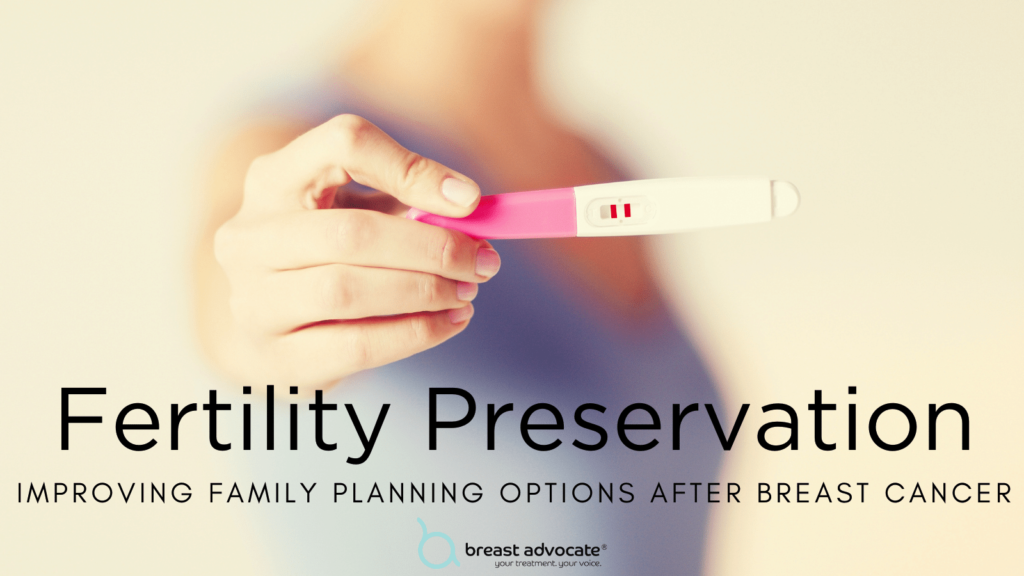
A common concern for many young women following a breast cancer diagnosis is the impact cancer treatment may have on their ability to have children. Certain cancer therapies like chemotherapy and radiation can greatly impact a woman’s ability to get pregnant and have a healthy pregnancy, but fertility preservation before breast cancer treatment may help.
A Swedish study published in JAMA Oncology found that fertility preservation at the time of a breast cancer diagnosis can increase the likelihood of a healthy pregnancy and birth after breast cancer treatments.
According to the National Cancer Institute, fertility preservation is “a type of procedure used to help keep a person’s ability to have children. A fertility preservation procedure is done before a medical treatment that may cause infertility, such as radiation therapy or chemotherapy. Examples of fertility preservation procedures include sperm banking, egg freezing, in vitro fertilization with embryo freezing, and certain types of surgery for cervical and ovarian cancer.”
The Swedish study followed 425 women with breast cancer who underwent fertility preservation between 1994 and 2017. The study control group consisted of 850 women diagnosed with breast cancer who did not undergo any fertility preservation. The results showed that 22.8% of women who had fertility preservation had at least one healthy pregnancy and birth following their breast cancer diagnosis, compared to 8.7% of women who did not have a fertility preservation procedure.
The women who opted for fertility preservation also reported having more children compared to the control group at 5 and 10 year follow-up.
It is important for women who may want to expand their families following a breast cancer diagnosis to be aware that cancer treatment may lead to infertility. Likewise, it is important for women and their doctors to engage in informed shared decision-making conversations to determine if fertility preservation options may be beneficial for future family planning.
How a COVID-19 Vaccine Will Impact Patients With Breast Cancer
This week, news broke that the drug company Pfizer has developed a vaccine for COVID-19. Pfizer and its partner company BioNTech reported that “individuals who received two injections of the vaccine three weeks apart experienced more than 90% fewer cases of symptomatic Covid-19 than those who received a placebo.” So far, Pfizer and BioNTech have reported no serious safety concerns.
The Phase 3 study is ongoing and additional data is still being collected. The effectiveness of a vaccine can only truly be determined once millions of people are vaccinated. However, experts say that the preliminary data indicates that the effectiveness should be very high. Pfizer will be seeking emergency use authorization from the FDA and anticipates having 50 million vaccine doses globally this year, and 1.3 billion next year.
The news of a vaccine is obviously fantastic. As many of us struggle to find balance in this new world, the feeling of hope that a vaccine brings is most welcomed right now. Despite this being one of the most rapidly developed vaccines in history, “COVID-19 fatigue” still makes it feel overdue.
Since this particular vaccine needs to be stored in extremely cold temperatures (-94°F), distribution headaches will need to be overcome before it can reach communities, starting with highest-risk populations. Unfortunately, it may be that many people outside urban areas and major medical centers have to wait for other vaccines to work their way through the development pipeline because of this refrigeration requirement.
As vaccines begin to roll out, patients with breast cancer will hopefully be able to be among the patients who benefit.
Routine Screenings, Diagnostic Tests and Clinic Visits
So many individuals, either with a history of breast cancer or a genetic predisposition to developing cancer, have either skipped or delayed their screening appointments due to fears of contracting the coronavirus. The full impact of these delays will likely not be known for many months to come, but doctors are urging patients to return to their normal screening schedules. Likewise, diagnostic tests and necessary in-person clinic visits (eg for infusions) should continue. Currently, hospitals, medical clinics, and doctor’s offices have protocols in place to decrease the risk of exposure and spread of this virus as much as possible. Healthcare workers are doing their best to give patients confidence in these safety measures, but a vaccine would go a long way in minimizing risk and easing fears further.
Surgery Scheduling
During the COVID outbreak, many hospitals and surgeons canceled elective (defined as “not immediately life-saving”) surgical cases to help reduce the burden on the healthcare system, to help preserve personal protective equipment (PPE) for healthcare workers, and to minimize potential exposure to the the virus. While elective procedures, including breast reconstruction, have mostly resumed, some patients remain fearful of proceeding with a procedure that may be able to wait and are therefore postponing scheduling. Additionally, infection numbers are once again increasing across the US raising the question whether another shut down of elective procedures is a possibility. A successful vaccine program would essentially ensure hospitals could return to normal pre-pandemic operative schedules while providing patients with some added peace of mind.
No Vaccine is ever 100%
Even if you receive the vaccine soon, it is important to remember that you will still not be completely protected. Until vaccination is widespread and we beat this pandemic, we strongly recommend you continue to protect yourself and follow the CDC guidelines.
Breast Advocate Proudly Supports Breast Reconstruction Awareness (BRA) Day
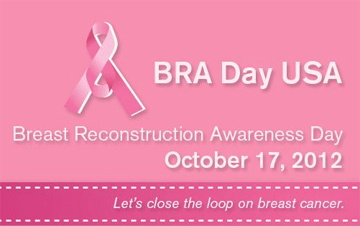
Breast cancer is the most commonly diagnosed cancer in women (after skin cancer), yet less than half of American women are offered the option of breast reconstruction after mastectomy or lumpectomy. Likewise, less than 25% of women are provided information on ALL breast reconstruction options available to them.
BRA Day’s primary mission aims to change these statistics! The annual Breast Reconstruction Awareness Day is celebrated on October 21st this year. According to the Plastic Surgery Foundation, the purpose of this day is to “educate, engage and empower women to make the decision that is best for them following a diagnosis with breast cancer. That involves informing women, family members, caregivers and the media that the breast cancer loop remains open until a woman is informed of breast reconstruction options.”
The mission of BRA Day is very much aligned with Breast Advocate’s! Co-created by leading specialists and patient advocates, Breast Advocate is a free breast cancer app that provides evidence-based information and treatment recommendations, personalized for users. These recommendations include a vast amount of information on ALL breast surgery options, including all types of reconstruction, and the option of no reconstruction. With the personalized information in a patients hand, it is our hope to empower individuals to have the conversation they want to have with their medical team.
In honor of BRA Day, Breast Advocate founder Dr. Minas Chrysopoulo joined BRCA Strong to discuss breast reconstruction options available to women and men today. Watch it below:
Advances in Breast Reconstruction Are Changing How Women “Feel” After Mastectomy

Many patients undergo a mastectomy as part of their breast cancer treatment. A mastectomy is a procedure that removes the breast tissue and, in some cases, the breast skin and nipple-areola. During mastectomy surgery, nerves that allow patients to feel (known as ‘sensory’ nerves) are often cut, leaving the patient numb.
Unfortunately, many patients are not told they could end up with a numb chest after their mastectomy, so this often comes as a shock to patients following surgery. This statement was recently echoed by NBC’s Kristen Dahlgren in an article published on Today.com who “…never realized that women who have mastectomies lose feeling in their chests.”
There is some good news though… Thanks to advances in surgical techniques, patients can now maintain or restore feeling following breast cancer surgery.
Sensory Nerve Preservation
The first step in preserving feeling is identifying and protecting the sensory nerves at the time of mastectomy, if the patient’s anatomy and diagnosis allows. During a mastectomy, surgeons must prioritize removing all tissue that looks and feels like breast tissue, otherwise the patient will not get the maximum benefit from the mastectomy in the first place. However, there are steps surgeons can take during the surgery to identify and preserve some of the nerves that provide feeling. However, sometimes this is not possible because of the patients’ anatomy, or because of the location of the breast cancer.
Sensory Nerve Reconstruction
Sensory nerve reconstruction (microneurorrhaphy) is a microsurgical technique designed to reconnect sensory nerves that were cut during the mastectomy. This can be performed with or without a nerve graft.
Most commonly, sensory nerve reconstruction is performed in conjunction with autologous (‘flap’) breast reconstruction procedures like the DIEP flap. However, nerve reconstruction is also possible with implant-based breast reconstruction.
Although the sensation that returns is not usually as good as that provided by Mother Nature before the mastectomy, for most patients, regaining some feeling is far preferable to the alternative of a numb breast.
Unfortunately, at this time, sensory nerve reconstruction is only performed at the time of breast reconstruction and is not offered routinely by all plastic surgeons. Patients must do their research to find a surgeon who offers and regularly performs this procedure.
5 Things You Should Know Before Having Breast Reconstruction Surgery
Breast implants are NOT the only option
The most commonly performed method of breast reconstruction performed today uses tissue expanders and implants. Although this approach is a good option for many, it’s not the only option. Likewise, implants may not be the best option for some patients. Reconstruction options using your own tissue (referred to as autologous or “flap” reconstruction) is also an option. In particular, after radiation treatment flap procedures are associated with fewer complications than implant-based reconstructions.
Sensory nerve reconstruction may be an option
Following a mastectomy, many patients experience permanent numbness to the chest area and reconstructed breast. This is because the sensory nerves that provide feeling are usually cut during the mastectomy. There is some good news though! Advances in breast reconstruction techniques have made sensory nerve reconstruction possible: reconnecting the sensory nerves in the chest can significantly improve the return of feeling to the reconstructed breast.
Enhanced Recovery After Surgery (ERAS) protocols are making recovery easier
Many surgeons are now implementing ERAS protocols to ensure their patients experience an easier recovery following breast cancer surgery, with or without reconstruction. Regardless of the type of reconstruction performed, ERAS protocols are reducing hospital stays, shortening recovery, and reducing the need for narcotics to control discomfort after surgery.
Shared decision-making matters
Breast reconstruction is not a one-size-fits-all procedure. Ensuring you discuss all your options and how they align with your lifestyle, preferences, and goals is critical in planning the best reconstructive option for you.
You can choose NOT to have breast reconstruction
It is important for patients to remember choosing NOT to undergo breast reconstruction and instead opting to “go flat” is an acceptable choice. Going flat (aesthetic flat closure) gives patients seeking no reconstruction the ability to maintain balance and symmetry without reconstructing the breast(s). Women can also choose to go flat after breast reconstruction if they are unhappy with their reconstruction results or have experienced complications after breast reconstruction.
To learn more about ALL your options, download the Breast Advocate App today!
BETting Against Brain Mets With Promising Combination Therapy
Breast cancer metastasis (also known as “stage IV”) occurs when cancer cells leave the breast and travel to other parts of the body in the bloodstream or via the lymphatic system. The most common sites of spread are the liver, brain, bones, and lungs. About 30% of women diagnosed with early-stage breast cancer will ultimately develop metastatic disease. About 55% of women with HER2-positive breast cancer will progress to stage 4. Metastasis greatly impacts long-term survival; for breast cancer patients whose cancer has metastasized to the brain, the life expectancy is only about six months.
Brain metastases are difficult to reach and often are not susceptible to the same treatments as breast cancers in other parts of the body because they are blocked by the blood-brain barrier. However, a new study from Northwestern Medicine is reports some positive findings on a new treatment option.
A new combination therapy including a class of drug known as a BET inhibitor, greatly decreased the size of brain mets and increased survival in mice. About 75% of the mice who underwent this new treatment were cancer-free following the treatment. The BET inhibitor appears to sensitize breast cancer brain metastases to vinorelbine, a drug already approved by the FDA, demonstrating a potentially very promising therapeutic combination.
“The new combination therapy we identified can cross the blood-brain barrier,” said lead study author Dr. Maciej Lesniak, Northwestern Medicine chair of neurological surgery and professor of neurosurgery at Northwestern University Feinberg School of Medicine. “The therapy also targets brain metastases and significantly improves survival.”
The drug I-BET-762, used in combination with vinorelbine in the study, is only approved for trials by the FDA at this time.